

Essential Skills to Begin Your Journey in Photography
- o2creats
- Mar 26
- 3 min read
Photography offers a powerful way to capture moments, tell stories, and express creativity. For beginners, the vast world of photography can feel overwhelming. Knowing where to start helps build confidence and skill quickly. This guide highlights the essential skills every new photographer should learn to create compelling images and enjoy the process.
Understanding Your Camera
Before taking photos, get familiar with your camera. Whether you use a DSLR, mirrorless, or even a smartphone, knowing how your device works is key.
Learn the basic controls: Understand how to adjust shutter speed, aperture, and ISO. These settings control how much light enters the camera and affect the final image.
Explore shooting modes: Try manual mode to gain full control, but start with aperture priority or shutter priority modes to practice specific settings.
Practice focusing: Learn how to use autofocus points or manual focus to get sharp images.
Spending time with your camera’s manual and experimenting with settings will build a strong foundation.
Mastering Exposure
Exposure determines how light or dark your photo appears. It depends on three main elements:
Aperture: The size of the lens opening. A wide aperture (small f-number) lets in more light and creates a blurred background effect.
Shutter Speed: How long the camera’s sensor is exposed to light. Fast shutter speeds freeze motion, while slow speeds create motion blur.
ISO: The sensor’s sensitivity to light. Higher ISO helps in low light but can add grain or noise.
Balancing these three settings is crucial. For example, to photograph a moving subject in low light, you might use a wide aperture, fast shutter speed, and higher ISO. Practice adjusting these settings in different lighting conditions to see their effects.
Composition Basics
Good composition makes photos visually appealing and guides the viewer’s eye.
Rule of Thirds: Imagine dividing your frame into a 3x3 grid. Place important elements along these lines or their intersections.
Leading Lines: Use natural lines like roads, fences, or rivers to lead the viewer’s eye into the photo.
Framing: Use objects like windows or branches to frame your subject.
Simplicity: Avoid clutter. Focus on one main subject to create a clear message.
Try composing shots with these ideas in mind. Over time, you’ll develop an eye for what works best.
Lighting Awareness
Light shapes every photograph. Learning to see and use light effectively is essential.
Natural Light: Early morning and late afternoon provide soft, warm light known as golden hour. Midday sun is harsh and creates strong shadows.
Direction of Light: Front lighting illuminates the subject evenly, side lighting adds texture and depth, backlighting creates silhouettes.
Artificial Light: Experiment with lamps, flashes, or reflectors to control light indoors or in low light.
Observe how light changes the mood and feel of your photos. Practice shooting at different times of day and with various light sources.
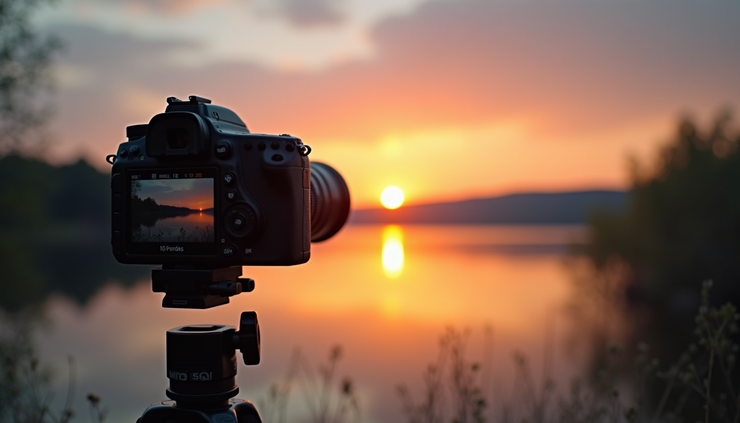
Camera set up for sunset photography showing the importance of lighting and composition
Focusing on Subjects and Storytelling
Photography is more than technical skills; it’s about telling stories through images.
Choose interesting subjects: Look for people, nature, architecture, or everyday moments that catch your eye.
Capture emotion and action: Photos that evoke feelings or show movement engage viewers.
Experiment with perspectives: Shoot from high, low, or unusual angles to add interest.
Think about what story you want to tell with each photo. This approach makes your work meaningful and memorable.
Post-Processing Basics
Editing helps enhance your photos and correct small issues.
Use simple tools: Start with basic adjustments like cropping, exposure, contrast, and color balance.
Avoid over-editing: Keep edits natural to maintain the photo’s original feel.
Learn software options: Free tools like Lightroom Mobile or Snapseed are great for beginners.
Editing is part of the creative process. It allows you to bring your vision to life after capturing the shot.
Practice and Patience
Photography skills improve with regular practice and patience.
Shoot often: Take photos daily or weekly to build experience.
Review and learn: Analyze your images to see what works and what doesn’t.
Seek feedback: Join photography groups or online forums to get constructive criticism.
Remember, every photographer started as a beginner. Progress comes from consistent effort and curiosity.


Comments